

How many dental implants are needed to replace all your teeth? Most patients do not need one implant for every missing tooth.
A complete arch can often be restored using four, six, or sometimes eight strategically positioned implants. The right number is selected after examining the jawbone, gums, bite, and type of final fixed teeth.
Quick Answer: How Many Dental Implants Are Needed?
Four to eight dental implants may be used to replace one complete arch of teeth. If both the upper and lower jaws require treatment, the total number may range from eight to sixteen implants.
Common treatment configurations include:
- Four implants for one complete arch with All-on-4
- Six implants for one complete arch with All-on-6
- Eight implants for one complete arch with All-on-8
- Different numbers in the upper and lower jaws when their conditions are not the same
These are treatment concepts, not fixed rules. A patient may receive four implants in one jaw and six in the other.
The final decision depends on where strong bone is available and how the implants can support the planned bridge. Placing more implants does not automatically create a better result.
What Is Full-Mouth Dental Implant Treatment?
Full-mouth dental implant treatment replaces all or most teeth in the upper jaw, lower jaw, or both. Instead of placing one implant beneath every missing tooth, several implants support a complete fixed bridge.
The bridge contains the visible replacement teeth and may also replace part of the missing gum tissue. It is attached to the implants and is not removed by the patient for daily cleaning.
This treatment may be described as full-mouth dental implants, full-arch dental implants, fixed teeth on implants, or an implant-supported bridge. Patients can learn more about implants dentaires en Albanie before considering a complete rehabilitation.
Who Is Full-Mouth Implant Treatment Suitable For?
Full-mouth implants may be suitable for patients who have lost all their teeth or have several teeth that cannot be treated successfully.
Potential candidates include people with:
- Dents multiples manquantes
- Severely damaged or loose teeth
- Advanced gum disease that has affected tooth support
- Large bridges that repeatedly fail
- Uncomfortable removable dentures
- Extensive decay across one or both jaws
- Enough general health to undergo implant surgery
The remaining teeth must be examined individually. Teeth should not be removed only to simplify the treatment if they can still be treated and maintained.
Smoking, uncontrolled diabetes, poor oral hygiene, active infections, certain medications, and untreated gum disease can affect the treatment plan. These conditions do not always make implants impossible, but they require careful evaluation.
Patients with limited jawbone may need dental bone grafting or advanced implant solutions. The appropriate option depends on the location and severity of the bone loss.
How Does Full-Mouth Dental Implant Treatment Work?
First Appointment
The first appointment determines how many implants are actually needed. The dentist examines the teeth, gums, bite, existing dental work, and condition of any removable dentures.
A panoramic X-ray provides an initial overview. A CBCT scan may then be used to study the height, width, and three-dimensional shape of the jawbone.
The treatment is planned around the position of the final teeth. The dentist must consider chewing forces, facial support, speech, cleaning access, and the relationship between the upper and lower jaws.
The examination also identifies which natural teeth can be saved. Any infection or active gum disease must be included in the treatment plan before the final restoration is made.
Treatment Stage
Teeth that cannot be saved are carefully removed. Four, six, or eight implants are then positioned in areas that can provide suitable support for the complete bridge.
When the implants achieve the required initial stability, a temporary fixed bridge may be placed shortly after surgery. This approach is known as implantologie à mise en charge immédiate.
Immediate fixed teeth are not possible in every case. If the implants are not sufficiently stable, the dentist may recommend a different temporary solution while healing takes place.
The temporary bridge is designed for the healing period. Patients must follow dietary instructions because excessive pressure can affect the implants before they integrate with the bone.
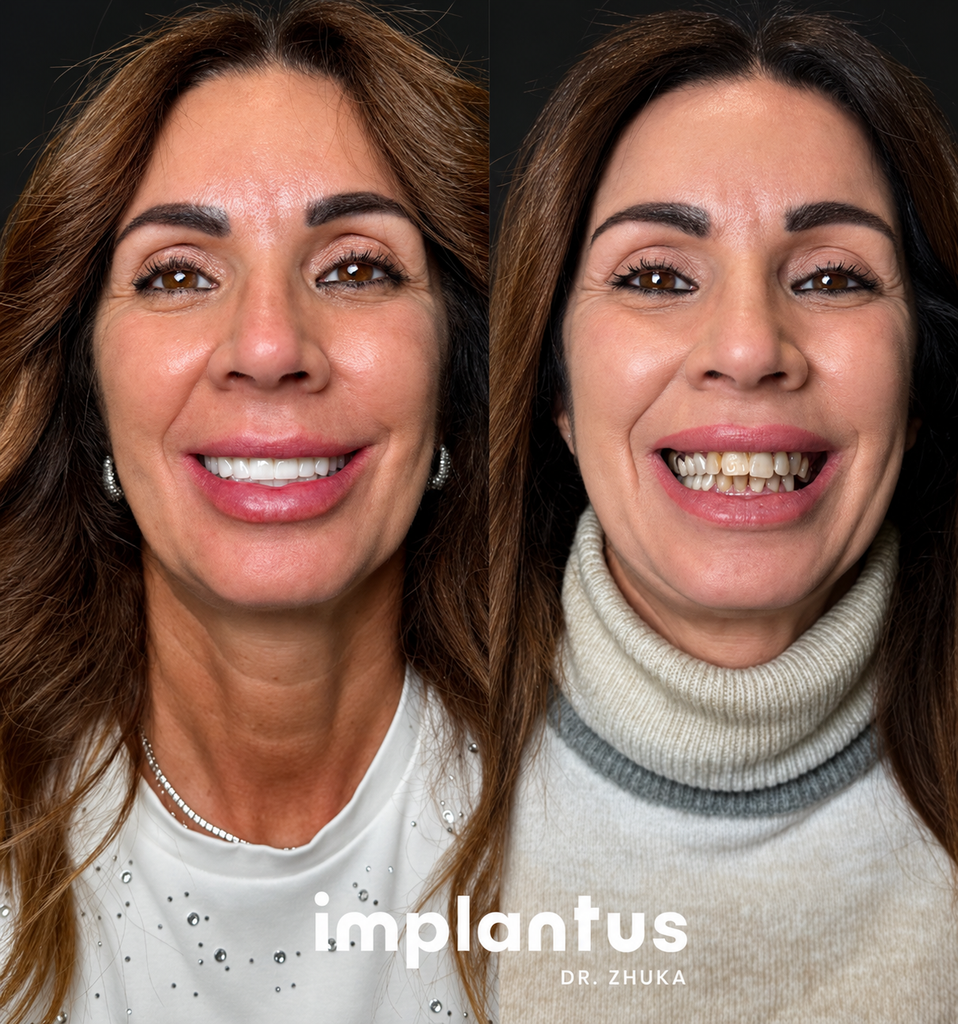
Restauration finale
After healing, the implants and surrounding tissues are examined again. Digital scans or impressions are taken to produce the final implant-supported bridge.
The dentist checks tooth length, colour, facial support, speech, bite, and cleaning access. A try-in may be completed before the definitive restoration is attached.
The final bridge is stronger than the temporary version and is designed for long-term function. Its material and construction are selected according to the clinical plan rather than appearance alone.
How Long Does Full-Mouth Implant Treatment Take?
Implant placement may be completed during one surgical stage. Suitable patients may receive temporary fixed teeth within approximately 24 to 48 hours.
The implants generally require several months to integrate with the jawbone. The final restoration is produced after the healing stage and the required clinical checks.
Treatment can take longer when the patient needs separate bone regeneration, treatment for infection, or healing after the removal of failed implants. Complex cases may therefore require additional stages.
Benefits of Full-Mouth Dental Implants
A complete fixed bridge can replace an entire row of teeth without requiring an individual implant for every tooth.
Important benefits may include:
- Fixed teeth that do not move like removable dentures
- Improved chewing stability
- Better support for the lips and lower face
- Restoration of a damaged bite
- Fewer implants than replacing every tooth individually
- A design adapted to the patient’s smile and facial proportions
- Easier speech for many patients after the adaptation period
Implants also transfer chewing forces to the supporting bone. However, they do not stop every natural change in the jaw and still require professional maintenance.
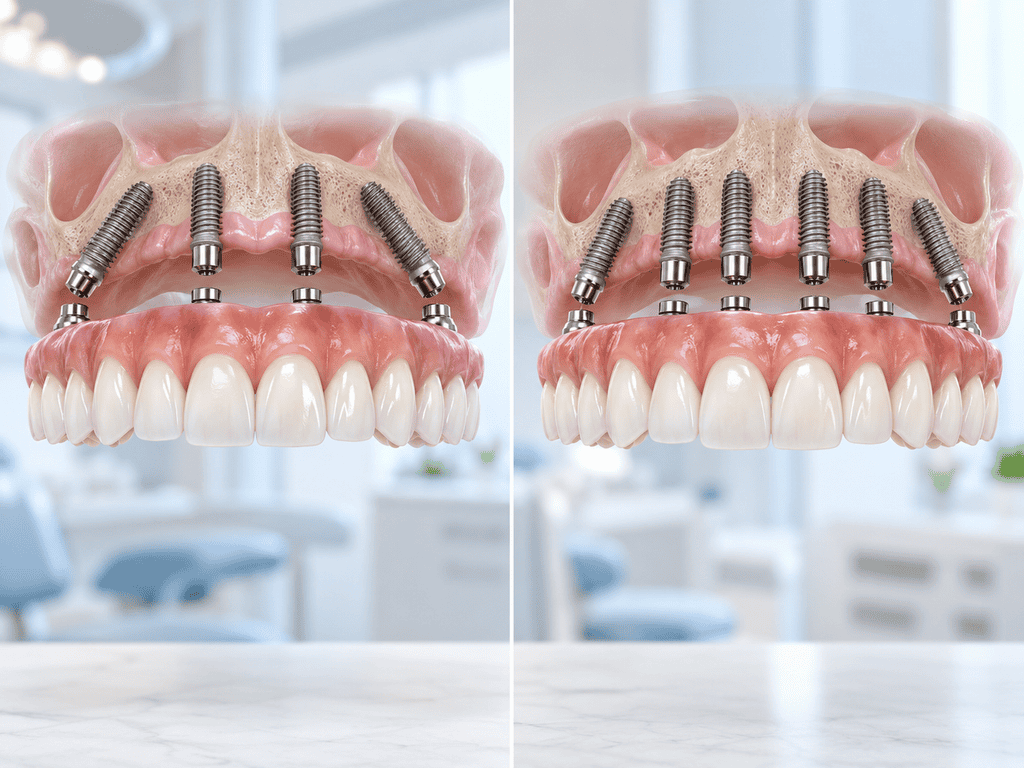
All-on-4 vs All-on-6
Implants dentaires All-on-4 use four implants to support one fixed arch. The implants are positioned to make effective use of the available bone.
Implants dentaires All-on-6 use six implants across the arch. This may provide additional support and a different distribution of chewing forces when the patient’s anatomy allows it.
| Facteur | Tout sur 4 | Tous sur 6 |
| Implants per arch | Four | Six |
| Bone requirements | May use selected areas of available bone | Requires suitable bone in additional positions |
| Surgical planning | Often chosen when posterior bone is limited | Considered when wider implant distribution is possible |
| Fixed bridge | Supports one complete arch | Supports one complete arch |
| Best option | Depends on the individual case | Depends on the individual case |
Neither treatment is automatically better for every patient. The choice should be based on bone anatomy, implant position, bite forces, bridge design, and the possibility of future maintenance.
Some patients may instead be considered for All-on-8 dental implants. Eight implants are not necessary for every arch and should only be used when they provide a clear clinical advantage.
Recovery and Aftercare
Swelling, tenderness, and mild bruising can occur during the first days after implant surgery. The patient should use prescribed medication correctly and follow the clinic’s dietary instructions.
A soft diet is normally required during the early healing period. Hard or sticky foods can place unnecessary force on the temporary bridge.
Daily cleaning must continue even though the replacement teeth cannot develop cavities. Plaque can still collect around the implants and cause inflammation in the surrounding tissues.
The patient may need a soft toothbrush, interdental brushes, floss designed for bridges, or a water flosser. The dentist should explain how to clean beneath the restoration without damaging the gums.
Increasing pain, persistent bleeding, fever, unusual swelling, or movement of the temporary bridge should be reported to the clinic.
How Long Do Full-Mouth Dental Implants Last?
Dental implants can remain functional for many years when they integrate correctly and receive consistent care. No implant treatment should be presented as permanent without maintenance.
The implants and the fixed bridge do not necessarily have the same lifespan. Although the implants may remain stable, the bridge or individual components can require repair or replacement because of wear.
Long-term results are influenced by oral hygiene, smoking, teeth grinding, gum health, bite forces, general health, and regular dental checks. A night guard may be recommended when the patient grinds or clenches their teeth.
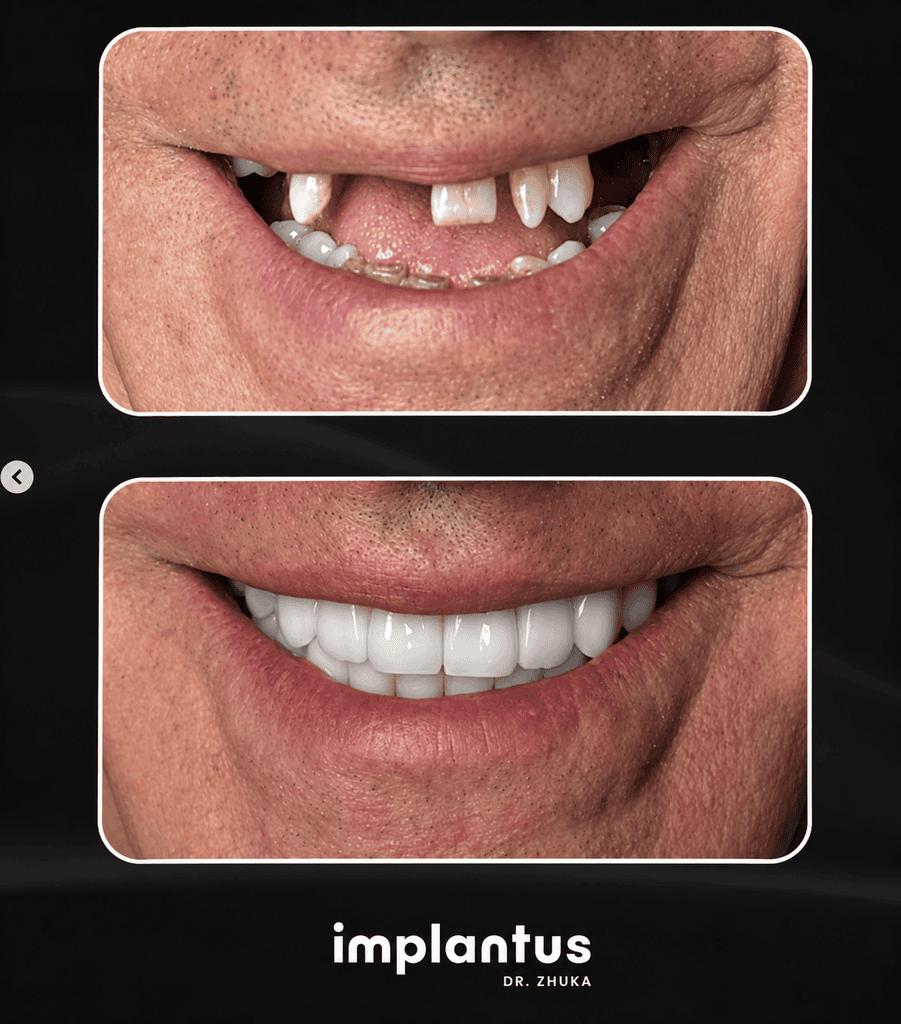
Full-Mouth Dental Implants in Albania for International Patients
International patients can begin their evaluation before travelling. Clear dental records help the clinic prepare a preliminary treatment direction and estimate the number of visits required.
Patients should normally send:
- A recent panoramic X-ray
- Complete CBCT files when available
- Clear photographs of the teeth and smile
- Information about previous implants or bone treatments
- Medical conditions and current medications
- Details about existing dentures, crowns, or bridges
The online evaluation may indicate whether four, six, or more implants could be required. The number is confirmed after the in-person examination and complete imaging in Tirana.
Patients planning le tourisme dentaire en Albanie should also understand the difference between temporary and final teeth. The treatment plan should explain the estimated implant number, type of bridge, healing period, number of trips, and follow-up arrangements.
Questions fréquemment posées
Do I Need One Implant for Every Missing Tooth?
No. A complete fixed bridge can be supported by several strategically distributed implants. Four to eight implants may replace one full arch, depending on the case.
How Many Implants Are Needed for Both Jaws?
Both jaws may be restored with eight implants using four per arch or twelve implants using six per arch. Other combinations are possible because the upper and lower jaws may have different bone conditions.
Are Six Implants Always Better Than Four?
No. Six implants may provide wider support when suitable bone is available, but four well-positioned implants can support a complete fixed arch in selected patients. Correct planning matters more than choosing the highest number.
Can I Receive Full-Mouth Implants If I Have Severe Bone Loss?
Severe bone loss does not always rule out fixed teeth. Possible approaches include bone regeneration, strategically angled implants, or advanced options such as implants zygomatiques for selected upper-jaw cases.
Conclusion
Most patients do not need one dental implant for every missing tooth. One complete arch is commonly supported by four, six, or sometimes eight implants.
The correct number cannot be selected from a package name alone. It must be based on the patient’s bone, gums, bite, health, and final bridge design.
Find The Right Implant Number Before Planning Your Trip 🦷
Do not choose between All-on-4, All-on-6, or All-on-8 without a personal evaluation.
Step 1 – Share your case: Send a recent panoramic X-ray, dental photos, and any available CBCT files.
Step 2 – Identify the treatment area: Explain whether you need treatment for the upper jaw, lower jaw, or both.
Step 3 – Review your preliminary plan: Learn the possible number of implants, treatment stages, healing period, and estimated travel schedule.
WhatsApp : +355 69 70 44 409
Courriel : info@dr-rolandzhuka.com
Localisation : Rruga Faik Konica, Tirana, Albanie
The right question is not how many implants can be placed. It is how many are needed to support your new teeth safely.


 Français
  English
  Italiano
  Shqip
Shqip