

Dental crowns in Albania can be placed over natural teeth or connected to dental implants. Both options restore the visible part of a tooth, but they do not have the same foundation.
A crown on a natural tooth protects an existing tooth. A crown on an implant replaces a tooth that is already missing or cannot be saved.
The Main Difference Is Below The Crown
The visible crown may look similar in both treatments. The main difference is the structure that supports it.
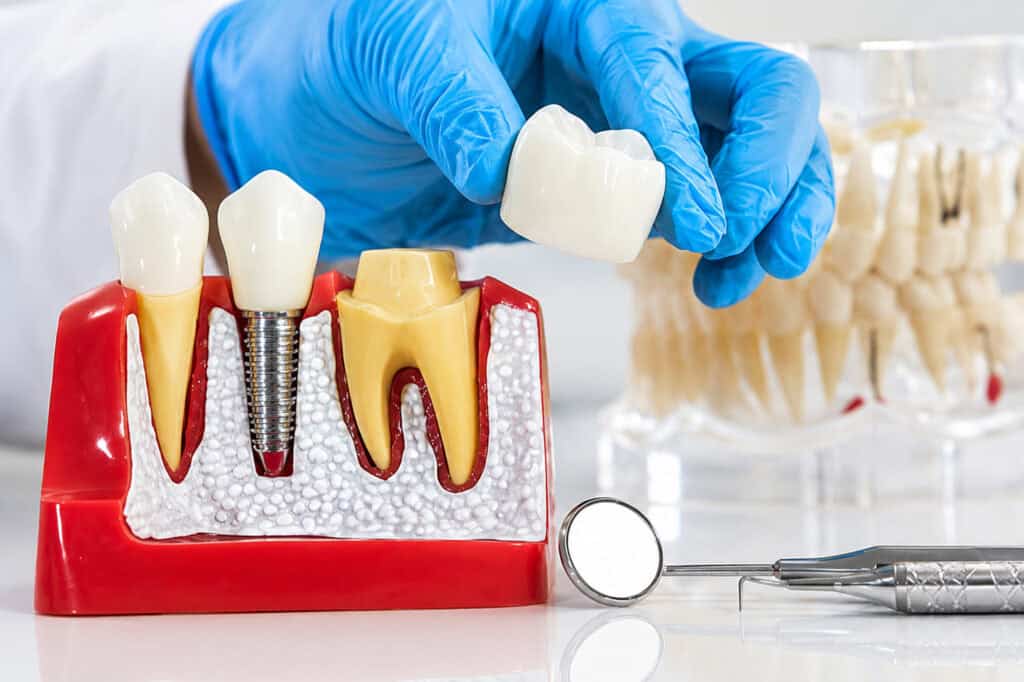
A natural tooth crown is placed over a prepared tooth. The natural root remains inside the jawbone.
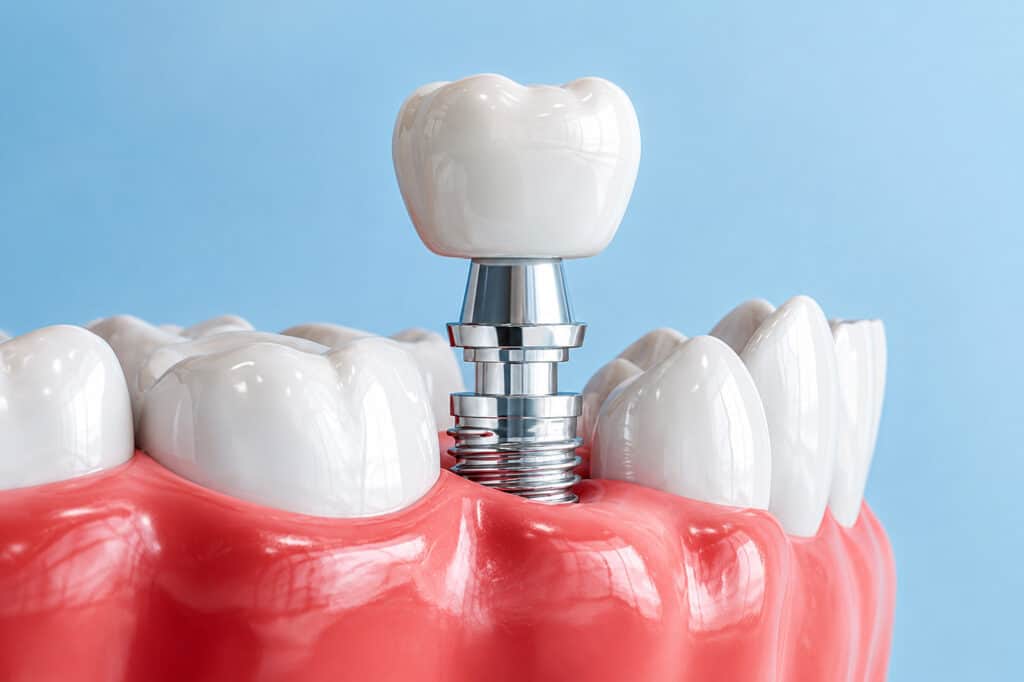
An implant crown is connected to an artificial tooth root. This root is the dental implant placed inside the jawbone.
| Factor | Crown on a natural tooth | Crown on a dental implant |
| Main purpose | Protects and restores an existing tooth | Replaces a missing tooth |
| Support | Natural tooth and root | Dental implant and abutment |
| Surgery | Usually not required | Required for implant placement |
| Tooth preparation | Natural tooth must be shaped | No natural tooth is prepared |
| Healing period | Usually short | Implant may need several months to heal |
| Risk of decay | The tooth below the crown can develop decay | The implant and crown cannot develop decay |
| Gum health | Gum disease can affect the tooth | Peri-implant inflammation can affect the implant |
| Sensation | Natural root and ligament remain | Implant has no natural tooth ligament |
| Connection | Crown is bonded to the prepared tooth | Crown is screwed or cemented to an abutment |
| Treatment time | Often completed in one trip | May require two trips when a new implant is placed |
Neither option is automatically better. The correct choice depends on whether the natural tooth can still be treated successfully.
What Is A Crown On A Natural Tooth?
A crown on a natural tooth is a custom restoration that covers the visible part of the tooth. It helps restore shape, strength, function, and appearance.
The natural root remains in the jaw. The dentist only prepares the part of the tooth above the gum.
At Implantus, patients can receive different types of zirconia and E-Max crowns based on the position of the tooth, bite pressure, and aesthetic needs.
When Is A Natural Tooth Crown Used?
A dental crown may be recommended when a tooth is too damaged for a simple filling. However, the tooth must still have enough healthy structure to support the restoration.
Common reasons include:
- A large filling that has weakened the tooth
- A broken or cracked tooth
- Severe tooth wear
- A tooth treated with root canal therapy
- A tooth with an irregular shape
- Significant discoloration
- The need to support part of a dental bridge
A crown does not repair every damaged tooth. The dentist must first check the root, surrounding bone, gum health, and remaining tooth structure.
How Is A Crown Placed On A Natural Tooth?
The dentist first removes damaged tissue and prepares the tooth. The preparation creates enough space for the crown.
A digital scan or dental impression is then taken. This records the shape of the prepared tooth, neighbouring teeth, and bite.
The main stages normally include:
- Clinical examination and X-rays
- Removal of decay or damaged material
- Preparation of the natural tooth
- Digital scan or impression
- Placement of a temporary crown when needed
- Production of the final crown
- Bite and fit checks
- Bonding of the final crown
The crown must fit closely around the prepared tooth. A poor fit can make cleaning difficult and may increase the risk of future problems.
What Is A Crown On A Dental Implant?
An implant crown replaces the visible part of a missing tooth. It does not cover a natural tooth because there is no natural tooth below it.
The restoration normally has three main parts:
- The dental implant inside the jawbone
- The abutment connected to the implant
- The dental crown connected to the abutment
Patients considering dental implants in Albania should understand that the crown is only one part of the complete treatment.
The implant acts as the artificial root. The abutment creates the connection between the implant and the visible crown.
How Is A Crown Connected To An Implant?
An implant crown can be screw-retained or cement-retained. Both methods are used in modern implant dentistry.
Screw-Retained Implant Crowns
A screw-retained crown is attached directly to the implant or abutment with a dental screw. A small access opening is used to reach the screw.
The opening is closed with a tooth-coloured material. The crown can often be removed more easily if the dentist needs to inspect, repair, or replace it.
Cement-Retained Implant Crowns
A cement-retained crown is bonded to an abutment. It can provide a clean surface without a visible screw access opening.
The dentist must carefully control the cement around the implant. Cement left below the gum can irritate the surrounding tissues.
The choice does not depend only on appearance. Implant angle, crown position, gum level, available space, and future maintenance must also be considered.
How Is An Implant Crown Placed?
If the implant has not been placed, treatment begins with implant surgery. The implant is inserted into the jawbone and given time to heal.
A temporary tooth may be used during this period. The type of temporary restoration depends on implant stability and the position of the missing tooth.
After healing, the dentist checks the implant and surrounding gum. A digital scan or impression is then taken to design the final crown.
The final stages include:
- Checking implant stability
- Selecting the correct abutment
- Recording the gum shape
- Taking a digital scan or impression
- Designing the crown
- Checking colour and shape
- Testing the bite
- Connecting the crown to the implant
A carefully designed implant crown should fit the bite and support the surrounding gum. It should also allow the patient to clean around the implant.
Can A Natural Tooth Crown And An Implant Crown Look The Same?
Both types can provide a natural-looking result. The material, colour, shape, surface, and gum position all affect the final appearance.
An implant crown in the front of the mouth can require more detailed planning. The implant position and gum shape must support a natural transition between the crown and the surrounding tissues.
A natural tooth already has its original root and gum connection. This can make the gum shape easier to preserve when the tooth is healthy enough to restore.
The goal is not to make every tooth perfectly identical. The crown should match the patient’s neighbouring teeth and facial features.
Do They Feel The Same?
A natural tooth has a periodontal ligament between the root and the bone. This ligament helps the tooth respond to pressure.
A dental implant is connected directly to the bone. It does not have the same natural ligament.
Patients can still chew normally with a well-planned implant crown. However, the bite must be adjusted carefully because the implant does not move in the same way as a natural tooth.
A crown on a natural tooth may feel more familiar because the original root remains. An implant crown may feel different at first, but most patients adapt after treatment.
Which Materials Can Be Used?
Natural tooth crowns and implant crowns can be made from similar dental materials. The best material depends on the tooth position, bite, available space, and required appearance.
Common options include:
- Zirconia
- E-Max ceramic
- Other all-ceramic materials
- Metal-ceramic
Zirconia is often selected when strength is an important part of the treatment plan. E-Max may be considered when light transmission and detailed aesthetics are important.
These are not strict rules for every patient. The dentist and dental technician must evaluate the complete case before selecting the material.
Can A Natural Tooth Under A Crown Develop Decay?
Yes. The crown itself cannot develop decay, but the natural tooth below it can.
Decay may begin near the crown margin if plaque collects in the area. A damaged crown margin can also allow bacteria to reach the tooth.
Good brushing, flossing, and professional checks help protect the tooth. The dentist should also examine the crown if it becomes loose or uncomfortable.
Can An Implant Crown Develop Decay?
No. An implant crown and a titanium implant cannot develop tooth decay because they are not natural tooth tissue.
However, this does not mean that an implant crown needs no care. Plaque can collect around the implant and irritate the gum.
Without proper cleaning, inflammation may develop around the implant. Long-term maintenance is therefore necessary for both implant crowns and natural tooth crowns.
How Does Daily Cleaning Differ?
A natural tooth crown is cleaned in a similar way to a normal tooth. The area where the crown meets the gum needs special attention.
An implant crown must also be cleaned around the gum and abutment connection. The dentist may recommend dental floss, interdental brushes, or other tools based on the available space.
Patients should not select cleaning tools without guidance. The wrong size or technique may damage the gum or fail to remove plaque.
What Problems Can Affect Each Type Of Crown?
The possible problems are different because the supporting structures are different.
Possible Problems With Natural Tooth Crowns
A natural tooth crown may be affected by:
- Decay below or around the crown
- Fracture of the remaining tooth
- Root infection
- Gum recession
- Crown loosening
- Ceramic chipping
- Bite discomfort
If the tooth remains treatable, the dentist may repair or replace the crown. If the root or tooth structure is severely damaged, extraction may become necessary.
Possible Problems With Implant Crowns
An implant crown may be affected by:
- Screw loosening
- Crown loosening
- Ceramic chipping
- Gum inflammation
- Bone loss around the implant
- Food collecting around the crown
- Bite pressure problems
A loose implant crown does not always mean that the implant has failed. The dentist must check whether the problem comes from the crown, screw, abutment, or implant.
Which Treatment Takes Longer?
A crown on a natural tooth is usually faster because implant surgery and bone healing are not required. International patients can often complete the treatment during one planned stay.
A new implant crown takes longer. The implant may need several months to integrate with the jawbone before the final crown is connected.
| Treatment | Typical number of trips | Main reason |
| Crown on a treatable natural tooth | Often 1 trip | No implant healing period is required |
| Crown on an existing healed implant | Often 1 trip | The implant is already integrated |
| New implant and implant crown | Usually 2 trips | Healing is required between implant placement and the final crown |
| Crown with additional bone treatment | 2 or more trips | Bone healing may be needed before the final restoration |
The exact schedule depends on the condition of the tooth, bone, gum, and implant. Patients planning dental tourism in Albania should receive a personal timeline before booking flights.
What If The Implant Was Placed In Another Country?
Implantus can evaluate implants placed by another clinic. However, the dental team needs information about the implant system.
Patients should bring their implant passport when possible. It may contain the brand, model, diameter, length, connection, and batch information.
This information helps the dentist identify compatible screws and abutments. Without clear records, extra imaging or research may be needed before a new crown can be produced.
The implant must also be checked for stability, position, gum health, and bone support. A new crown should not be placed only because the implant is visible in an X-ray.
Should A Natural Tooth Be Removed And Replaced With An Implant?
A treatable natural tooth should not be removed only because an implant is available. Preserving the natural tooth may be the better option when the root, bone, and surrounding tissues are healthy enough.
An implant may be recommended when the tooth cannot be restored in a stable way. This can happen because of a deep fracture, severe structural damage, advanced infection, or poor bone support.
The decision must be based on a full clinical examination. It should not be based only on the price or appearance of the crown.
Crowns On Implants Vs Crowns On Natural Teeth: Which Is Better?
The treatments solve different problems.
A crown on a natural tooth is usually considered when the tooth can still be saved. It protects the remaining structure and keeps the natural root.
An implant crown is considered when the tooth is missing or cannot be restored successfully. It replaces both the root support and the visible tooth.
The correct question is not simply which crown is better. The correct question is which foundation can provide the safest and most stable result for that specific tooth.
Frequently Asked Questions
Is An Implant Crown The Same As A Dental Implant?
No. The dental implant is the artificial root inside the bone. The crown is the visible tooth connected to it.
Can The Same Crown Fit A Natural Tooth And An Implant?
No. The internal design and connection are different. Each crown must be made for its specific foundation.
Can An Implant Crown Be Replaced?
Yes. An implant crown may be replaced if it becomes damaged or no longer fits correctly. The implant and abutment must first be examined.
Can A Natural Tooth Crown Be Replaced?
Yes, if the tooth below it remains healthy and has enough structure. Additional treatment may be required if decay or fracture is present.
Which Crown Looks More Natural?
Both can look natural when they are planned correctly. The result depends on material, position, gum shape, colour matching, and dental laboratory work.
Do Implant Crowns Need Regular Dental Checks?
Yes. The dentist must check the crown, screw or cement connection, gum, bite, and bone around the implant.
Final Thoughts
Crowns on implants and crowns on natural teeth may look similar, but they have different foundations. A natural tooth crown protects a tooth that can still be treated. An implant crown replaces a tooth that is missing or cannot be saved.
The correct choice depends on the condition of the tooth, root, gum, and bone. Careful planning helps protect function and creates a result that looks balanced and natural.
Which Type Of Crown Do You Need? Let Us Check Your Case 🦷✨
Do not choose a crown based only on material or appearance. The structure below the crown is just as important as the visible result.
Contact Implantus by Dr. Roland Zhuka for a personalised online evaluation:
- 📸 Send your panoramic X-ray and dental photos
- 🦷 Learn whether your natural tooth can be restored
- 🔩 Find out if an implant crown is necessary
- 🎨 Receive guidance about zirconia, E-Max, and other materials
- ✈️ Get a clear treatment and travel schedule before coming to Tirana
WhatsApp: +355 69 70 44 409
Email: info@dr-rolandzhuka.com
Location: Rruga Faik Konica, Tirana, Albania



 English
  Italiano
  Shqip
Shqip  Français