

Nasal implants for severe bone loss are not something I recommend casually. They are advanced implants used in very specific cases, usually when the upper jaw has lost so much bone that traditional implants cannot be placed safely or strongly enough.
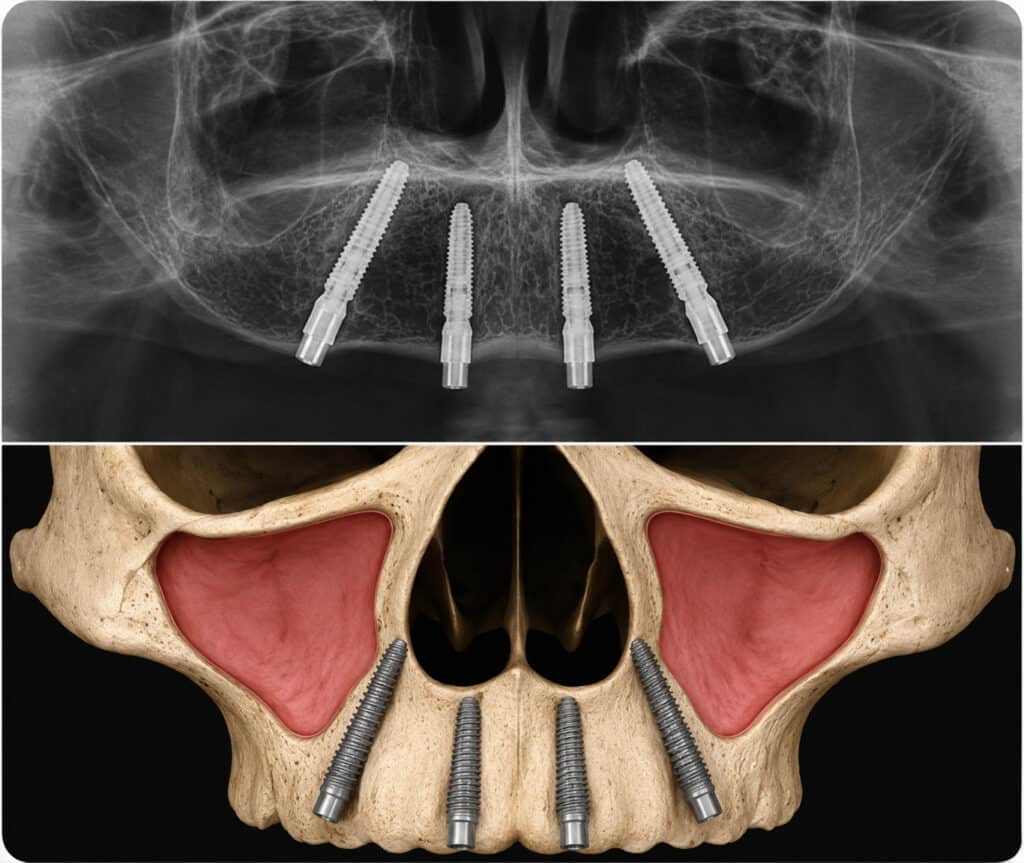
Many patients hear the word “nasal” and think the implant goes inside the nose. It does not. In dental implantology, nasal implants use the strong bone around the nasal floor and the side of the nose to support fixed teeth in patients with major upper jaw bone loss.
At Implantus Dental Clinic in Tirana, I use them only after a detailed 3D scan, clinical examination, bite analysis, and a clear discussion with the patient. The goal is simple: fixed teeth that are stable, functional, and designed for long-term use.
What Are Nasal Implants?
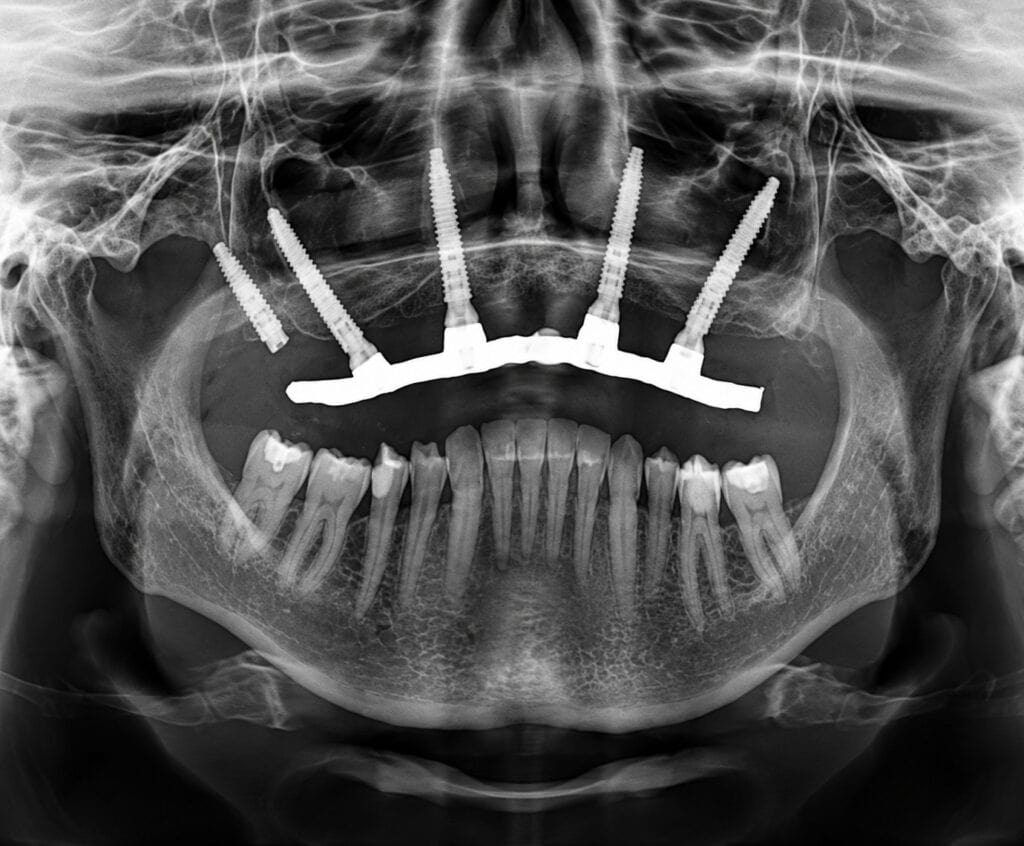
Nasal implants are dental implants placed in the upper jaw in a way that allows them to engage dense bone near the nasal cavity, especially around the nasal floor and piriform rim. This area can remain strong even when the usual implant zones in the upper jaw have resorbed badly.
They are not cosmetic nose implants. They do not change the shape of your nose. They are dental implants designed to support teeth when the jawbone has become too thin, too short, or too weak for standard placement.
I usually consider nasal implants as part of a full-arch rehabilitation. That means a patient may be missing all teeth in the upper jaw, wearing a loose denture, or facing the removal of failing teeth because of infection, gum disease, or old dental work that cannot be saved.
If you want a deeper explanation of this technique, you can read more about nasal implants in Albania and how we plan them at our clinic.
Why Severe Upper Jaw Bone Loss Creates a Special Problem
The upper jaw is different from the lower jaw. The bone is usually softer. The maxillary sinuses sit close to the back teeth. After teeth are lost, the bone shrinks, and the sinuses often expand downward into the space where implants would normally go.
This is why some patients are told, “You don’t have enough bone for implants.” Sometimes that is true for standard implants. But it does not always mean fixed teeth are impossible.
In severe cases, placing short or narrow implants in weak bone is a mistake. They may look acceptable on the day of surgery, but they cannot carry the forces of chewing for many years. I would rather say no to a weak plan than give a patient teeth that will fail early.
And this is where advanced anchorage becomes important. Nasal implants, zygomatic implants, pterygoid implants, and carefully selected bone grafting techniques can give us options when standard implants are not enough.
Nasal Implants for Severe Bone Loss: When I Recommend Them
I recommend nasal implants for severe bone loss when the front part of the upper jaw is too resorbed for reliable conventional implants, but the bone around the nasal floor offers strong anchorage. This is not decided by looking in the mouth alone. It is decided on a CBCT 3D scan.
The question I ask is not, “Can I place an implant somewhere?” The question is, “Can I place an implant in the correct position, with enough stability, to support a fixed bridge that the patient can use comfortably?”
When the Upper Jaw Has Collapsed After Years of Dentures
Long-term denture wear often causes the upper jaw to shrink. The denture may become loose, the face may look more aged, and the patient may avoid chewing harder foods. I see this often in patients who have worn removable dentures for 10, 15, or 20 years.
In these cases, the front bone may be very thin. Nasal implants can help by reaching stronger anatomical areas instead of depending only on the weak ridge where the teeth used to be.
When Standard All-on-4 Is Not Strong Enough
All-on-4 dental implants can be an excellent treatment for many full-arch cases. Four implants, placed at planned angles, can support a full fixed bridge when the bone anatomy is suitable.
But in some patients, the upper jaw has lost too much bone for a classic All-on-4 approach. If the front implants cannot be placed with good length, angle, and primary stability, the plan needs to change. Nasal implants may be added to improve support in the anterior maxilla.
When We Want to Avoid Large Bone Grafting
Bone grafting can be very useful. I perform grafting when it is the best biological option. You can learn more about our approach to bone grafting for dental implants on the clinic website.
Still, not every patient wants, needs, or can tolerate a large graft. Some grafts require months of healing before implants can be loaded. For an international patient traveling to Albania, or for someone who has already suffered years with dentures, this waiting period may be a serious burden.
Nasal implants can sometimes reduce or avoid the need for major grafting because they use existing strong bone. That does not mean they are easier. It means the treatment strategy is different.
When Immediate Fixed Teeth Are Possible
Many patients ask me one question before anything else: “Doctor, can I leave with fixed teeth?”
Sometimes yes. If the implants achieve high primary stability and the bite can be controlled safely, nasal implants may be part of an immediate loading implant treatment. This means the patient receives a fixed temporary bridge shortly after surgery, often within 48 hours.
The temporary teeth are not the final teeth. They are designed to let the implants heal while giving the patient comfort, speech, and dignity. The final bridge comes later, after the implants have integrated with the bone.
When Nasal Implants Are Not the Right Choice
Not every severe bone loss case needs nasal implants. I say this clearly because advanced does not automatically mean better. The best implant is the one that fits the anatomy, the bite, the smile, and the patient’s health.
If a patient has enough bone for standard implants, I do not make the surgery more complex. If zygomatic implants are more appropriate, I use zygomatic anchorage. If the posterior maxilla needs support and the anatomy allows it, pterygoid implants may be a better part of the plan.
Nasal implants may not be recommended if there is active infection around the nasal area, untreated sinus or nasal pathology, very poor general health, uncontrolled diabetes, heavy smoking with poor healing risk, or unrealistic expectations about the procedure.
That last point matters. Fixed teeth are life-changing, but they are not magic. They require hygiene, follow-up, and correct maintenance.
How I Plan Nasal Implants at Implantus Dental Clinic
Planning is where the success of this treatment begins. I do not decide this type of surgery from a panoramic X-ray alone. A panoramic image is useful, but it cannot show the full three-dimensional anatomy needed for safe planning.
We use CBCT imaging to measure bone height, width, density, nasal floor anatomy, sinus position, implant angles, and the relationship between the future teeth and the available bone. The teeth must guide the implant plan, not the other way around.
The Smile and Bite Are Planned Before Surgery
A common mistake in implant dentistry is placing implants first and thinking about the teeth later. In full-arch treatment, that can create bulky teeth, poor speech, bad cleaning access, or an unnatural smile line.
At our clinic, we plan the final prosthetic result early. As Albania’s first and only Digital Smile Design certified clinic, certified in London in 2024, we look at facial proportions, lip movement, smile display, and tooth shape before deciding the exact implant strategy.
This is especially important with nasal implants because the implant position must support a bridge that looks natural and can be cleaned properly.
The Surgery Must Respect the Anatomy
The nasal floor, sinus region, and upper jaw anatomy leave no room for careless surgery. The implant must be placed at the correct depth and direction, with controlled drilling and a clear understanding of the surrounding structures.
I trained in advanced implantology in Rome, zygomatic implantology at Saint Camillus International University in Rome, and bone reconstruction at Goethe University Frankfurt with Hürzeler/Zuhr Academy. These trainings matter, but experience matters too. After more than 20 years placing implants, I know that every millimeter in an atrophic maxilla counts.
Do Nasal Implants Hurt?
During surgery, patients should not feel pain. We use local anesthesia and sedation options when needed, depending on the patient and the procedure. Many patients are surprised that the recovery is more manageable than they imagined.
After surgery, swelling, mild bruising, pressure, and tenderness are normal. Some patients feel pressure near the nose or upper lip for a few days. This is expected because the surgical area is close to the nasal structures.
Pain is controlled with medication and clear aftercare instructions. I always tell patients: discomfort is normal, strong uncontrolled pain is not. If something does not feel right, we want to know immediately.
Nasal Implants vs Zygomatic Implants
Nasal implants and zygomatic implants are both used in cases of severe upper jaw bone loss, but they are not the same. Zygomatic implants anchor into the cheekbone, which is often very strong even when the upper jaw has almost disappeared.
Nasal implants use strong bone around the nasal floor and side of the nose. In some full-arch cases, I may combine different implant types to create a stable foundation across the entire upper jaw.
For example, zygomatic implants may support the back region, while nasal or conventional implants may support the front. In another case, pterygoid implants may be better for posterior support. The scan decides. The patient’s bite decides. The final bridge design decides.
What Results Can Patients Expect?
The result we want is not only “teeth that stay in.” That is the minimum. I want patients to chew, speak, smile, and look like themselves again.
With a well-planned full-arch bridge, the face often gains better support because the teeth and gums are rebuilt in the correct position. The patient no longer has a loose denture moving during speech. Food choices improve. Confidence changes quickly.
But I am careful with promises. Severe bone loss cases are complex. Healing must be monitored. The temporary bridge must be protected. The final bridge must be made with precision, often in zirconia or another strong material depending on the case.
If you are comparing treatment plans, ask this: is the dentist only offering implants, or are they planning the full function, smile, hygiene access, and long-term maintenance?
Why Patients Travel to Albania for Advanced Implant Treatment
Many of our international patients come from Italy, the UK, Germany, Switzerland, and other European countries. The reason is not only price, although treatment in Albania can cost considerably less than in Western Europe.
They come because they want an experienced implantologist, digital planning, fixed teeth quickly when medically possible, and a clinic that handles complex bone loss cases regularly. Implantus Dental Clinic is located inside one of Tirana’s premier private hospitals, near Air Albania Stadium, which also gives patients comfort and confidence.
Dental tourism should never mean rushed treatment. It should mean smart planning, clear communication, and realistic timing. Some patients can complete surgery and temporary teeth in one visit. Others need staged care. I prefer to tell the truth from the beginning.
FAQ About Nasal Implants for Severe Bone Loss
Are nasal implants safe?
Nasal implants can be safe when they are planned with CBCT imaging and placed by an experienced implant surgeon. The key is respecting the nasal floor anatomy and choosing the right patient. They are not a routine implant for simple cases.
Will nasal implants affect my breathing?
Properly planned nasal implants should not affect breathing. They are placed in the jawbone near the nasal floor, not inside the airway. If a patient has nasal or sinus problems, we evaluate this before surgery and may request additional medical assessment.
Can nasal implants replace bone grafting?
Sometimes they can reduce or avoid the need for large bone grafting, especially in severe upper jaw bone loss. In other cases, grafting is still the better choice. The decision depends on bone volume, infection history, bite forces, smile design, and the number of implants needed.
How long do nasal implants last?
With good planning, proper surgery, a well-made bridge, and regular maintenance, nasal implants can last many years. Long-term success also depends on hygiene, smoking habits, general health, and how well the bite is controlled.
Can I get fixed teeth in 48 hours with nasal implants?
In selected cases, yes. If the implants are stable enough at placement, we can often provide fixed temporary teeth within 48 hours. If the bone or implant stability is not ideal, delayed loading is safer.
Are nasal implants more expensive than regular implants?
They usually cost more than standard implants because the planning, surgery, and prosthetic design are more complex. At our clinic in Tirana, prices are still often much lower than in the UK, Italy, or Germany. A correct quote requires a scan and case evaluation.
Thinking About Nasal Implants?
If you have been told you have severe upper jaw bone loss, do not assume removable dentures are your only option. Nasal implants for severe bone loss may be part of the solution, but they must be recommended for the right reasons.
Send us your panoramic X-ray or CBCT if you already have one. We will review your case, explain what is realistic, and tell you whether nasal implants, zygomatic implants, pterygoid implants, bone grafting, or another approach makes the most sense.
Contact Implantus Dental Clinic in Tirana for a free quote through WhatsApp or our online form. You can also reach us at +355 69 70 44 409 or info@dr-rolandzhuka.com.



 English
  Italiano
  Shqip
Shqip  Français